Tar in Vitebsk, then the color
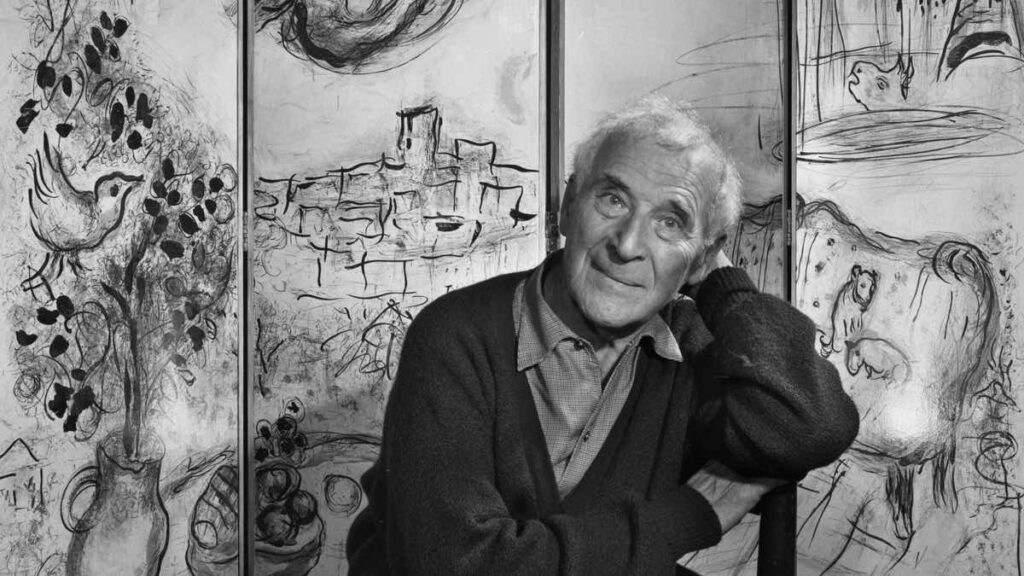
Marc Chagall grew up in a Hasidic Jewish family in Vitebsk, Russian Empire. He passed through the studio of Yehuda Pen, then Saint Petersburg and Léon Bakst. In 1911, a scholarship brought him to Paris, to La Ruche. He takes what he needs from Cubism and Fauvism, without ever giving up the mantle. War is holding him back in Russia. He married Bella Rosenfeld, for a time directed the Fine Arts in Vitebsk, decorated the Jewish Theatre in Moscow. In 1923, he left Russia for good.
The world upside down, and the Bible
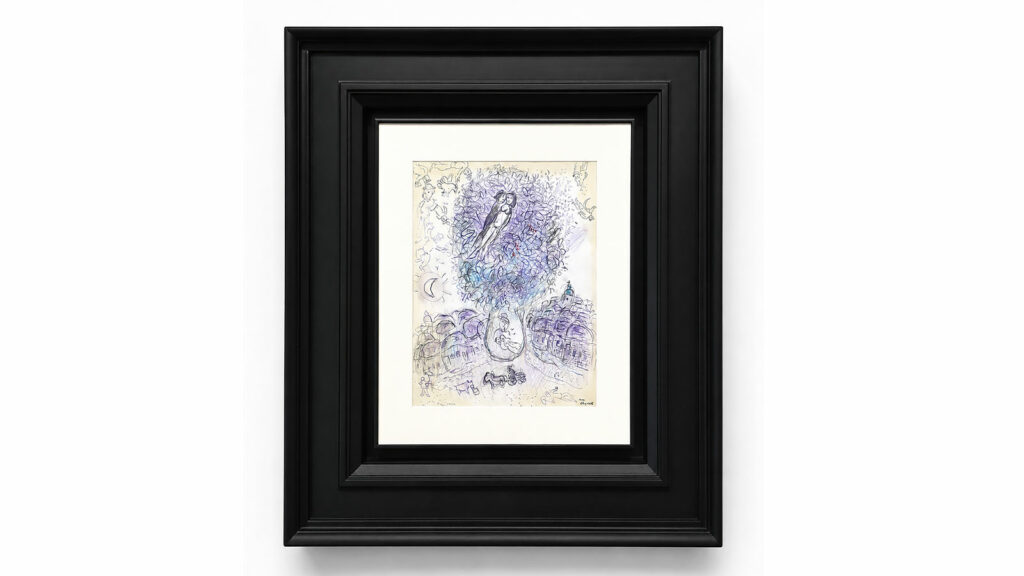
Back in Paris, Vollard commissioned Gogol, La Fontaine, and then the Bible. Lovers float, the violinist walks on rooftops, Vitebsk returns like an alphabet. In 1937, he became French; Vichy stripped him of his nationality. Exiled to New York, Bella died in 1944. After the war, the dream changed scale: ceiling of the Paris Opera, stained glass windows, mosaics, tapestries.
A work to the end
Chagall moved to Saint-Paul-de-Vence. The Marc Chagall National Museum opened in Nice in 1973. He refuses to be only « surrealist »: the wonderful, with him, comes from memory and color, not from a manifesto. He died on 28 March 1985, after a final lithography session.